Garmin Approach G82
The GPS + Launch Monitor Hybrid That Actually Works
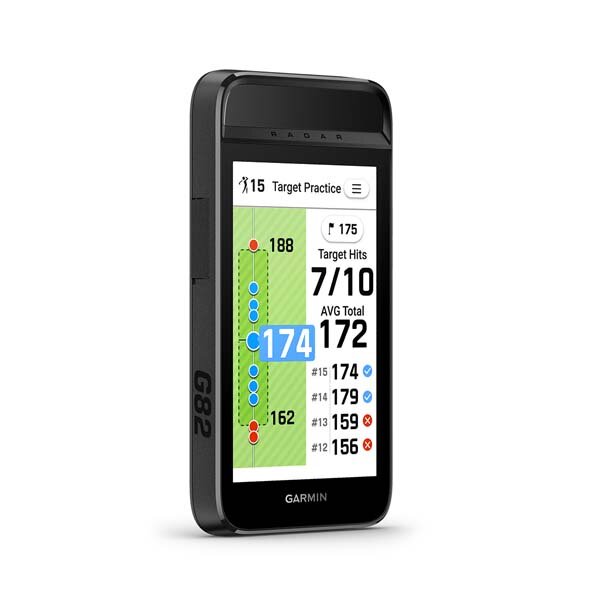
The Garmin Approach G82 is brilliant at what it does — merge a top-tier handheld GPS with a capable range launch monitor. It's the best tool for the golfer who wants one device for the range AND the course. But it is NOT a home simulator launch monitor. If you want to hit balls in your garage with GSPro, buy the R10 instead. If you want real course yardages, range practice data, and putting feedback in one device that fits in your golf bag — this is the only choice.
Garmin Garmin Approach G82 · $599
What We Love
- +Only product on the market that combines GPS and launch monitor in one device — seamless one-button toggle
- +No subscription required — ever. Buy it once, use it forever
- +25-hour GPS battery / 8-hour radar — multiple rounds between charges
- +43,000+ preloaded courses with detailed hole maps, green contours, hazard distances
- +Built-in 5-inch transflective touchscreen — no phone needed at all
- +Virtual caddie learns your distances over time and recommends clubs based on real data
- +Putting metrics: stroke length, tempo, club speed, ball speed
- +IPX7 waterproof — use it in the rain without worry
What Sucks
- −Limited to 5 basic metrics — no spin rate, no launch angle, no club path, no face angle
- −No simulator support — no GSPro, no E6, no virtual course play whatsoever
- −Bulky for walking golfers (6.3 x 3.3 x 0.9 inches, 10.9 oz) — better for cart riders
- −Range-only for launch monitor mode — does NOT work indoors
- −Estimated carry distance ±5 yards — not Trackman-level precision
- −At $599, it costs more than the Garmin R10 ($499) which offers more LM data and sim compatibility
Watch It in Action
You’ve probably never asked this question: why do you need two devices to practice golf?
You carry a GPS for yardages. Or you have an app on your phone. And if you want launch monitor data — ball speed, club speed, how far you’re actually hitting it — you need a separate device that lives in your garage or costs $2,000.
Garmin looked at that problem and said: what if we just put both in one box?
The Garmin Approach G82 is a handheld GPS golf watch-adjacent device (it’s not a watch) that also functions as a Doppler radar launch monitor. It’s the first product to genuinely merge these two categories. And I spent some time with it to figure out whether the hybrid is a breakthrough or a compromise.
Spoiler: it’s a breakthrough. But only if you understand what it actually is.
What This Thing Actually Is
Garmin’s marketing makes this confusing, so let me be clear:
The G82 is NOT a home simulator launch monitor. It will not connect to GSPro. It will not let you play Pebble Beach on a projector in your garage. If that’s what you want, stop reading and go buy the Garmin R10 instead.
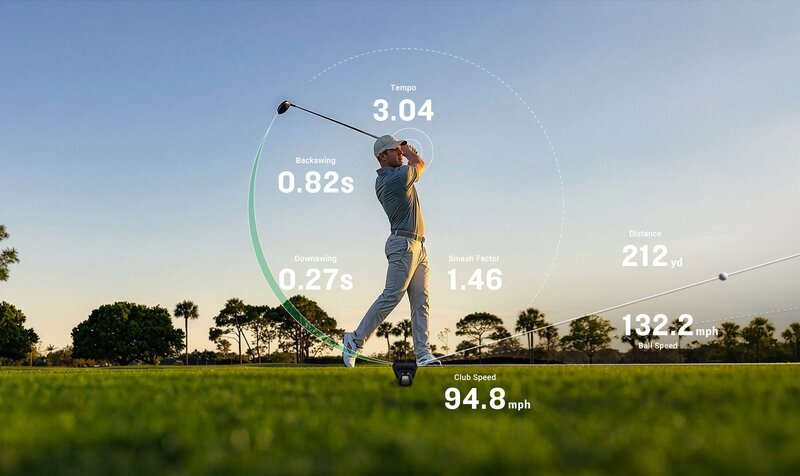
The G82 is a range-and-course tool. You take it to the driving range. You set it down behind you (it uses a golf ball as part of its stand — seriously, and it’s genius). You hit balls. It tells you ball speed, club speed, smash factor, tempo, and carry distance. Then you take it to the course. You flip one button. Now it’s a GPS with 43,000 course maps, hole layouts, green contours, hazard distances, and a virtual caddie that learns your clubs.
One device for the range and the course, with no subscriptions and no phone needed.
That’s the whole pitch. And it’s a good one.
What It Measures
The data is where most people get confused.
The G82 tracks five metrics:
Ball speed — how fast the ball leaves the clubface. This is the most important number in golf, and the G82 gets it right. Independent Golf Reviews tested it against a $2,000 launch monitor and found ball speed was “spot on every time.”
Clubhead speed — how fast you’re swinging. Good feedback for speed training.
Smash factor — ball speed divided by club speed. The efficiency number. Higher is better. Pro-level is 1.50 with driver.
Swing tempo — the ratio of backswing to downswing. Underrated metric. Most amateurs rush the transition, and seeing your tempo number is genuinely useful feedback.
Estimated carry distance — Garmin rates this at ±5 yards accuracy. In testing against the Rapsodo MLM2PRO, independent reviewers found it within a few mph and yards on most shots.
That’s it — no spin rate, no launch angle, no club path, no face angle, no apex height, no descent angle.
The G82 is not a fitting tool. It’s not a data firehose. It gives you the five numbers that answer the question “am I hitting this club better than last week?” and nothing more.
For most golfers, that’s enough. For the nerd who needs spin numbers to optimize their launch conditions? You need a different device.
The GPS Side Is World-Class
The G82’s GPS is genuinely world-class — the best handheld GPS on the market.
Forty-three thousand preloaded courses. That’s more than you’ll ever play. The hole maps are detailed — green contours, hazard carry distances, layup zones. You can drag the pin to its actual position on the green. The virtual caddie feature learns your club distances over time (from launch monitor sessions) and recommends clubs based on your real data, not averages.
And the screen. Five inches. Transflective, so it’s readable in direct sunlight (which is where you play golf). Bright, clear, responsive touchscreen.
The magnet on the back is absurdly strong. Sticks to the cart arm, doesn’t fall off. Comes with a carabiner for walking — though at 10.9 ounces, it’s a bit bulky for the walking purist.
Battery Life: The Actual Winner
Twenty-five hours in GPS mode. That’s four rounds of golf minimum, even if you’re playing slow. Eight hours in radar mode — enough for multiple range sessions.
I can’t overstate how nice this is. You charge it once a week. Maybe. The Garmin R10 has 10-hour battery. The SC4 Pro has 8-hour. The R10’s predecessor had people charging before every session. The G82 is the first device where I genuinely don’t think about the battery.
Putting Metrics (Yes, Real Putting Data)
This surprised me. The G82 tracks four putting metrics: stroke length, tempo, club speed, and ball speed.
Is this as good as a $500 putting-specific device like the ExPutt? No. But it’s real data from a device you already own, and it’s useful feedback for anyone who’s never seen their putting stroke quantified.
See how they compare: Garmin Approach G82 vs. ExPutt — the putting specialist vs. the multi-tool.
The one-trick: you need to line the ball up just right and the radar needs a clear path. It’s not perfect. But it’s a bonus feature that genuinely adds value at no extra cost.
What It’s Not
I keep coming back to this because the G82’s biggest weakness is expectation mismatch. People see “launch monitor” and “$599” and think they’re getting a garage simulator friend.
You’re not.
The G82 does not work indoors. It’s radar-based and needs the ball to fly at least a few feet before it can read it. No garage mode. No net mode. No sim.
It also doesn’t measure spin. At all. Not estimated, not calculated — nothing. That means no shot shape feedback. No launch angle. No way to know if you’re hitting it high or low. “Smash factor is good” tells you efficiency. It doesn’t tell you trajectory.
Compare this to the Garmin R10 at $499, which gives you launch angle, spin rate (estimated), spin axis, and full sim compatibility via GSPro. The R10 is less portable and has worse battery. But it’s a more complete data device for anyone who wants to actually improve.
Who Should Buy the Garmin G82
The range-and-course golfer. You hit balls at the range twice a week and play on weekends. You want one device that gives you practice data AND course yardages. You don’t want to mess with your phone on the course. You don’t want a subscription. The G82 is built for you.
And if you want the full ranked list: Our Best Outdoor Golf Launch Monitors for the Driving Range 2026 guide covers every outdoor LM from $180 to $2,000 — with battery life comparisons, sunlight readability scores, and which ones also work in your garage.
The data-curious but not data-obsessed. You want to know your club distances. You want to know if you’re swinging faster than last month. You don’t need to debate launch angles on Reddit. The five metrics are perfect.
The cart rider. If you ride 90% of your rounds, the G82 stays on the cart arm, charges once a week, and does everything. It’s a bit bulky for walking, but if you’re riding it’s perfect.
Who Should NOT Buy the Garmin G82
Anyone who wants a home simulator. Go buy the Garmin R10 ($499) or the Voice Caddie SC4 Pro ($499). The G82 has zero sim support. Zero.
The walking purist. 10.9 ounces is noticeable in your bag over 18 holes. The carabiner helps, but it’s big. If you walk and carry, look at a GPS watch instead.
See how they compare: Garmin R10 vs Garmin Approach G82 → — the $499 home sim vs the $599 range/course companion. Same brand, completely different tools.
The data obsessive. You want spin rates, launch angles, club path, face angle. You want to argue about shot shaping on forums. The G82 will frustrate you. Get an MLM2PRO at $599 or a SkyTrak+ at $1,995.
Don’t forget the right balls. See our best golf balls for simulator guide →
Final Verdict
The Garmin G82 is the best device on the market for the specific golfer it’s designed for. The GPS is genuinely world-class — better than any standalone handheld I’ve used. The launch monitor data is basic but accurate. The battery is ridiculous. No subscription.
But it is NOT a simulator device. Garmin made two products at the same price point — the R10 for sim, the G82 for range-and-course — and they could not be more different.
The cheat sheet:
- Want to hit balls in your garage with GSPro? Buy the Garmin R10.
- Want GPS + range data in one device with no subscription? Buy the Garmin G82.
- Want both? Buy the G82 for the course and a cheap net setup. But don’t expect the G82 to replace a sim launch monitor.
|Read the full comparison: Garmin R10 vs Garmin Approach G82 | |And if you’re shopping for a sim launch monitor — the G82 is NOT one — check the Best Launch Monitors 2026 guide for the products that actually work in a garage.
Need the right balls for the Garmin Approach G82? → Check our Best Golf Balls for Simulator guide (RCT recommended for indoor spin accuracy)
Head-to-Head Comparisons
Want to see how the Garmin Approach G82 stacks up against the competition?